7 Condo Association Budget Red Flags That Could Bankrupt You in 2026
I almost bought a condo last spring that looked perfect—stainless steel appliances, a pool, and granite countertops. But then I cracked open the condo association budget. The numbers were so bad I actually laughed out loud, then started sweating. That budget had all the warning signs of a slow-motion financial train wreck, and if I'd ignored them, I could have been on the hook for $30,000 in surprise fees within two years. Let me tell you, reading a condo budget isn't sexy, but it's the single most important thing you can do before signing. Here are the seven red flags that could bankrupt you in 2026.
When I first started looking at condos, I thought the monthly HOA fee was the only number that mattered. Boy, was I wrong. The budget tells you everything about whether you're buying a home or a money pit. A poorly planned budget doesn't just mean higher fees—it means special assessments, lawsuits, and potentially losing your investment. In 2026, with construction costs still climbing and insurance rates spiking, these red flags are more dangerous than ever. Let's get into them so you don't make the same mistake I almost did.
Why Your Condo's Budget Is More Dangerous Than a Special Assessment
Most people fear a special assessment because it's a big, unexpected lump sum—say, $10,000 for a new roof. But here's the thing: a special assessment is a symptom, not the disease. The disease is a budget that doesn't plan for the future. A single special assessment can sting, but a chronically underfunded budget can lead to multiple assessments, deferred maintenance that lowers property values, and even a board that mismanages your money into a lawsuit. I've seen condos where owners were hit with three special assessments in two years because the budget had no reserves, no contingency, and no plan. That's what bankrupts you—not one big bill, but a cascade of them.
The condo association budget is the financial blueprint of the building. It shows how much money comes in (from your dues, parking fees, rental income) and how much goes out (maintenance, insurance, management). If it's built on wishful thinking or outright neglect, you're the one who pays. In 2026, with inflation still squeezing operating costs, a weak budget is like a ticking time bomb. So let's look at the seven red flags that should make you walk—or at least negotiate hard.
Red Flag #1 – Zero or Minimal Reserve Fund Contribution
This is the big one. The reserve fund is the condo's savings account for major repairs—roofs, elevators, parking garages, siding. Industry best practice, per the Community Associations Institute, is that associations should be at least 70% funded based on a recent reserve study. But I've seen budgets where the reserve contribution is zero. Literally zero dollars set aside for future repairs. That means when the roof starts leaking in 2026, every owner gets a special assessment for the full cost.
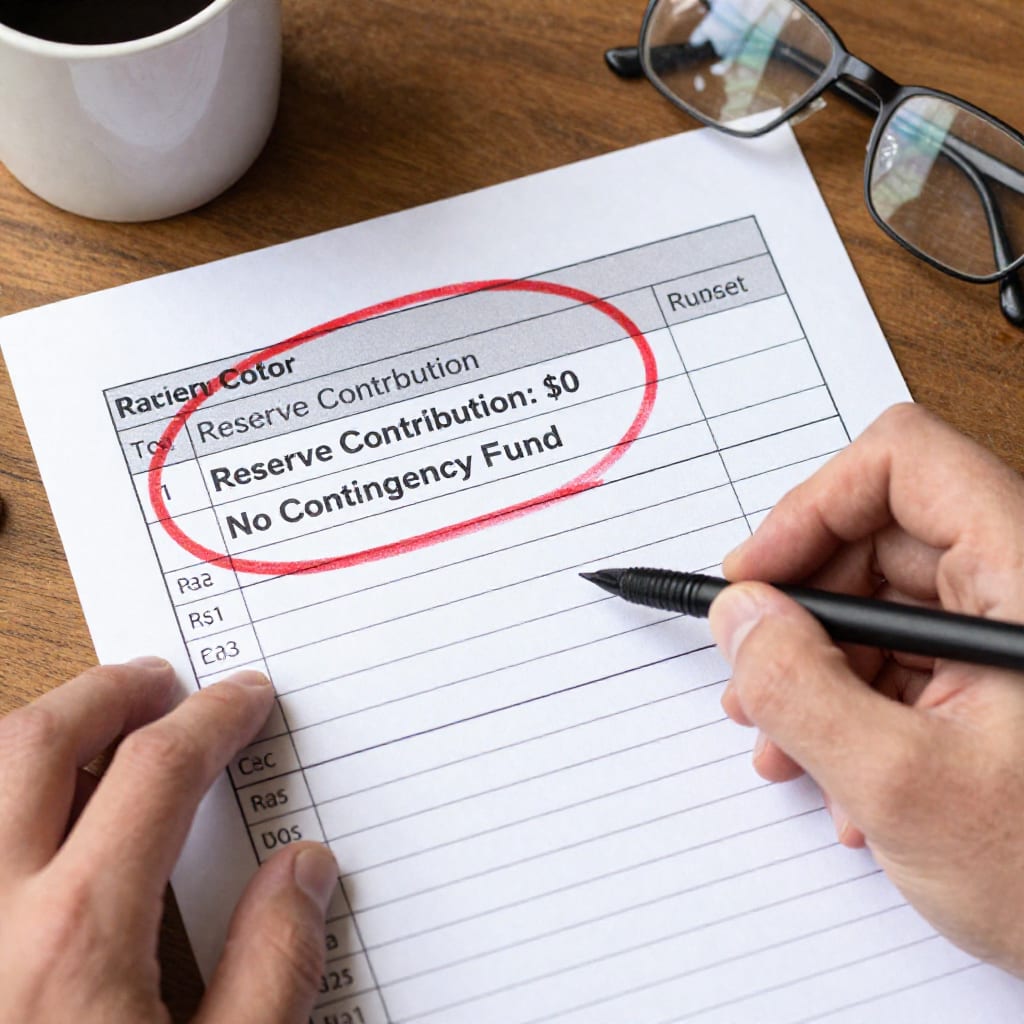
In my own search, I looked at a building where the reserve fund had only $15,000 for a 40-unit complex. The reserve study said they needed $400,000 for upcoming roof and elevator work. That's a $385,000 shortfall. Divide by 40 units, and each owner was looking at nearly $10,000 in assessments—and that's just for two items. The kicker? The budget showed no increase in reserve contributions for the next three years. I walked away, and six months later, the building announced a $12,000 special assessment. If you see a budget with zero or tiny reserve contributions, run. Ask for the most recent reserve study and check the funding percentage. If it's below 50%, you're buying a future bill.
Red Flag #2 – Deferred Maintenance Line Items (Or None at All)
A good budget has specific line items for regular maintenance: roof inspection, HVAC servicing, elevator annual check, landscaping, pest control. A bad budget lumps everything into a vague "repairs and maintenance" bucket with no detail. I once saw a budget that allocated just $2,000 for "building maintenance" in a 20-year-old building. That's not maintenance—that's a prayer. When I asked the board president about the roof, he said, "Oh, it's fine, we'll deal with it when it leaks." That's deferred maintenance in action.
Deferred maintenance is a silent killer because costs compound. A $5,000 roof patch job now becomes a $50,000 full replacement later because the leak damaged the decking and insulation. In 2026, with labor and materials still expensive, deferring maintenance is a recipe for emergency assessments. Look for line items that cover major systems: roof, HVAC, plumbing, electrical, elevators, and parking. If they're missing or tiny, the building is living on borrowed time. The original insight here? A budget that shows no maintenance line items is actually worse than one with a low reserve contribution—because at least reserves can be built up. Deferred maintenance is already happening, and the costs are already growing.
Red Flag #3 – Overly Optimistic Income Projections
Budgets are supposed to be conservative. But some boards get creative with income. I've seen budgets that assume 100% of owners will pay their dues on time every month (hint: they won't), that parking spaces will always be rented at top dollar, and that late fees will collect in full. One budget I reviewed projected $50,000 in annual rental income from a single commercial unit that had been vacant for two years. The board was counting on a tenant that didn't exist. When the income doesn't materialize, the shortfall gets passed to owners through higher dues or special assessments.
In 2026, with remote work still reducing demand for some commercial spaces and inflation squeezing household budgets, overly optimistic income projections are a huge red flag. Check the actual collection rate—ask for the past two years of financial statements. If the budget assumes 98% collection but actual history is 92%, that's a gap. Also look at rental income assumptions: are they based on current market rates or pie-in-the-sky numbers? A realistic budget should include a 5–10% cushion for non-payment or vacancies. If it doesn't, the board is hoping, not planning.
Red Flag #4 – Insurance Deductible Gaps and Underinsurance
Insurance is a beast right now. Premiums are up, deductibles are higher, and many associations are underinsuring to keep dues low. But the real trap is the deductible gap. Let's say a water pipe bursts and causes $50,000 in damage. The condo's insurance policy has a $25,000 deductible. If the budget has no line item for insurance deductibles, guess who pays? You, via a special assessment. I talked to a guy in Florida whose building got hit with a $30,000 deductible after a hurricane—and the budget had set aside zero for that. He had to come up with $5,000 out of pocket.
Check the budget for a line item called "insurance deductible fund" or "self-insured retention." If it's missing, ask the board how they handle deductibles. Also ask for a copy of the master insurance policy and check whether it covers replacement cost or actual cash value. Replacement cost is better—actual cash value deducts depreciation, leaving you with less. In 2026, with climate risks rising, underinsurance is a ticking bomb. Don't ignore it.
Red Flag #5 – Mysterious Legal and Professional Fees
Every condo has some legal costs—drafting documents, reviewing contracts, handling disputes. But when legal fees are way above average for the building's size, something's wrong. I looked at a budget where legal fees were $40,000 for a 30-unit building. That's $1,333 per unit. When I asked, the board said it was "ongoing litigation"—they wouldn't say more. That's a red flag the size of a billboard. High legal fees often mean the board is suing or being sued, which can lead to huge costs or even a special assessment to pay a judgment.
Management fees can also be suspicious. If the management company's fee is well above market rate for the area, either the board is overpaying or there's a conflict of interest. Ask for a breakdown: what services does the management company provide? Is it a flat fee or percentage-based? Also look for "special counsel" or "consultant" fees without explanation. Budget transparency should be the norm, not the exception. If the board won't explain a big line item, that's a trust issue. And trust issues cost money.
Red Flag #6 – Zero or Low Contingency Fund
The contingency fund is like an emergency credit card for the operating budget—it covers unexpected expenses that aren't big enough to tap the reserve fund. A burst pipe, a broken gate, an emergency snow removal. Most experts recommend a contingency fund of at least 5–10% of the annual operating budget. I've seen budgets with zero contingency. That means any unplanned expense triggers a special assessment or a loan from the reserve fund (which is a bad idea).
In 2026, with supply chain issues still causing price spikes for materials, a missing contingency is a huge risk. Imagine the HVAC system fails in July. Without contingency, the board has to either borrow money (adding interest costs) or hit owners with an emergency assessment. A good budget shows a line item like "contingency" or "unexpected repairs" with a reasonable amount. If it's zero or under 3%, ask why. The board might say, "We've never needed it." That's not an answer—that's luck, and luck runs out.
Red Flag #7 – No Annual Budget Review or Audit Trail
This is the most subtle red flag, but it might be the most important. A budget that hasn't been reviewed annually—or worse, hasn't been audited—is a black box. I once asked for the past three years of financial statements from a condo I was considering, and the board said, "We don't have them." That's not just a red flag; it's a siren. Without an annual review, the board can't catch errors, overspending, or even fraud. And without an audit trail, you have no way to verify that the budget numbers are real.
Look for evidence of an annual meeting where the budget was presented and voted on. Check the meeting minutes for discussions about budget variances. If the board can't produce past budgets or financial statements, that's a huge warning. In 2026, with rising costs and tighter margins, transparency is non-negotiable. I'd also ask if the association has had a recent audit or financial review by an independent CPA. If they say no, that's a deal-breaker for me.
How to Protect Yourself Before You Buy (or Before 2026 Hits)
So you've seen the red flags. Now what? First, request the full budget, the most recent reserve study, and the past two years of financial statements. Don't just look at the numbers—ask questions. Compare the reserve study's funding recommendation to the actual reserve balance. Ask about any pending litigation or special assessments. If the budget has multiple red flags, negotiate the purchase price down by the estimated cost of future assessments. In one case, I advised a friend to subtract $15,000 from his offer because the reserve fund was underfunded by that amount per unit. The seller accepted.
You can also ask the seller to pay for a year of HOA dues or set up an escrow for future assessments. Consult a condo-savvy real estate agent or attorney who knows how to read these documents. And if you're already an owner, push your board to adopt best practices: annual budget reviews, reserve studies every three to five years, and transparent financial reporting. In 2026, the condos with healthy budgets will hold their value. The ones without will become financial traps. Don't let yours be one of them.
Practical Takeaway: Before you buy, get the budget, the reserve study, and the past two years of financials. Look for these seven red flags. If you see three or more, walk—or negotiate a discount equal to the estimated risk. Your wallet will thank you.